
Categories
Torts

US v Carroll Towing

US v Carroll Towing is one of Judge Learned Hand’s most famous tort opinions. Judge Learned Hand served on the second circuit court of appeals, and is often called the greatest circuit court judge. For more biographical information, here is a good article on Judge Learned Hand.

Contract with US Government

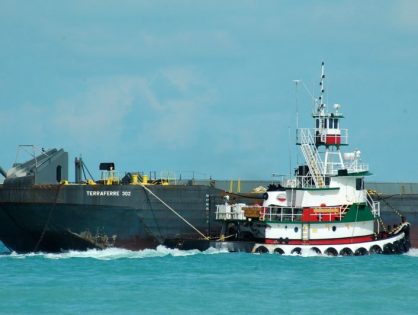
The case starts off in the New York City harbor during World War II. The Pennsylvania Rail Road was shipping flour owned by the United States government in its railway cars. When the railway cars arrived in New York City, the railroad rented the barge Anna C. from Connors Marine. They then moved the railway cars onto the barge in the harbor.

As part of their rental agreement, Connors Marine promised to provide a sailor. The sailor, or what the case calls a bargee, was supposed to be on the barge between 8 am and 4 pm every day. Because of wartime conditions, barges were daisy-chained to each other from the pier, extending out into the harbor.

The Scene
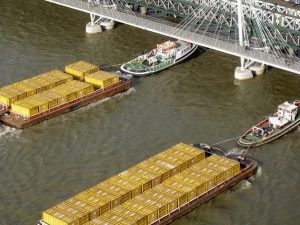
tug boats and barges, like the ones in US v Carroll TowingThe Anna C. was moored at pier 52 along with five other barges, all lashed one right next to the other. Over at the next pier, called the public pier, four barges were secured in the same manner. The captain of the tugboat Carroll found these two rows of barges and needed one of
the barges in the public pier next to the Anna C. But to get his barge he needed to remove a rope that connected the two rows of barges.

So the captain of the tug sent two employees onto the barges to remove the rope—the case calls one of the employees a bargee and the other a deckhand. They untied the rope and got their barge, but they forgot to retie the rope once they were done.

Drifting Boats

After a few minutes the rope that secured the Anna C. broke from the pier and all six barges started to float away. It was about 2:00 p.m.

After drifting for a few minutes, the Anna C. crashed into the propeller of a nearby tanker, ripping a hole in the Anna C.’s hull that could not be seen from outside the ship because the hole was under the water line.

The captain of the tugboat rushed back and secured the Anna C. to the pier, but he was unaware of the hole. The Anna C. filled with water and sank into the harbor, destroying all the flour owned by the United States.

It is clear that if Anna C.’s employee had been on board he would have found the hole and kept the Anna C. from sinking.

Negligence

The issue in US v Carroll Towing is whether Connors Marine breached its duty of care by failing to have an employee on board the Anna C. during working hours, as required by its contract. (As an aside, check out this video for a little more help on issue spotting.)

Learned Hand used the following algebraic formula to explain breach of duty: B<PxL. B is the burden of taking adequate precautions; P is the probability of harm and; L is the gravity of the harm. For a more detailed explanation, you can watch a video the explains the Learned Hand formula in more detail.

As applied to this case, the burden for Connors Marine was keeping an employee on the barge during working hours. Next, we look at the probability of harm. In a busy wartime harbor with many barges being moved in and out, that is fairly high. Finally, we look at the gravity of harm. If a barge were to break loose, the harm would likely cause significant damage. Learned Hand held that Connors Marine, the barge owner, breached its duty of care and was therefore negligent for failing to have an employee on board the Anna C. when she sank.

If you are still struggling with the Learned Hand formula, you may want to use the elaborative interrogation technique,


 

Categories
Torts

Proximate Cause

Raise your hand if you perfectly understand proximate cause (aka “legal cause”). No one? Read to the end as I explain how this concept works and how to use it on an exam.

Definition

In every tort, a plaintiff must prove that the defendant was not only the actual cause of the injury, but also the proximate cause of the injury. Proximate cause requires the plaintiff’s harm to be a reasonably foreseeable consequence of the defendant’s wrongful action. In a negligence case, there must be a relatively close connection between the defendant’s breach of duty and the injury.

Proximate cause is sometimes difficult for students to grasp. Why? Because it can be used to eliminate liability for a negligent defendant who caused the harm to the plaintiff. You are probably asking: why would the law eliminate liability for someone who was at fault in causing the plaintiff’s injury? In very rare cases, the events leading to the injury are freakish, remote, or improbable; or, there may be a superseding intervening event that injured the plaintiff. In these cases, the defendant is not the proximate cause of the injury, even though all the other elements are met.  (See my video on intervening causes for a more in-depth explanation on unforeseeable intervening events).

When deciding if someone is not the proximate cause of an injury, the law looks for an unforeseeable type of injury or superseding intervening event. A superseding intervening event is another term for an unforeseeable intervening event. When examining an unforeseeable type of injury, the law ignores the unforeseeable manner or extent of injury.

Rat on Fire

For example, in one case, the owner of a building negligently maintained an exposed pilot light, which had the potential to cause a fire. One would have expected the carpet or someone’s clothes to catch on fire, but instead, in this case, a rat ran by the exposed flame, its fur caught on fire, it ran into a hole, and the building caught on fire, causing damage to the plaintiff’s property in his apartment.

Now, though the manner of how the building caught on fire was unforeseeable, it was still a foreseeable consequence that the owner’s negligence would result in a fire. Therefore, the owner was the proximate cause of the fire.

Eggshell Plaintiff

Also, the law ignores the unforeseeable extent of injury in what is called the eggshell plaintiff rule. For example, if someone negligently backs into the car of a 95-year-old, causing her outrageously high medical bills, the defendant is still the proximate cause of the injury. You take the plaintiff as you find them.

In real life, plaintiffs prove proximate cause 99.99% of the time. In other words, proximate cause isn’t difficult to prove. So why do we spend so much time discussing a topic that has so little real-world application? Because proximate cause is the darling of law professors and bar examiners! For a more detailed discussion, you can read the proximate cause article by Professor Paul Hayden.

Example: Boiling Enamel

Cauldron. Used in proximate cause hypothetical

Let’s work through a fact pattern. Duffy is in the road construction business, and uses boiling enamel as part of the construction process. Duffy sets up a cauldron near a busy road, but he fails to set up any barriers in front of the boiling enamel. He also fails to place a person in front of the enamel to direct traffic away from it.

For the first element in a negligence action, Duffy had a duty to act reasonably under the circumstances. Second, Duffy breached his duty because a reasonable person would have taken a few basic precautions. For example, he should have placed a barrier around the boiling enamel. Also, he should have had people with flags on the road to get people to slow down. Under these facts, Duffy clearly acted unreasonably.

Suppose though that instead of a car crashing through and hitting the enamel, we have an airplane with engine problems. Pilot sees the road and decides to land. He lands at a point near Duffy, at which point the boiling enamel splashes on Perry. Under these facts Duffy isn’t the proximate cause of the harm because the airplane was a superseding intervening event that broke the causal link.

Foreseeability is the Norm

In real life, injuries are almost always a foreseeable consequence of the negligent conduct. If someone is speeding down the road, the foreseeable consequence is an injured pedestrian or another car. When a waiter fails to clean up a water spill, it’s reasonably foreseeable that someone is going to fall. Or, if an airplane mechanic fails to put enough oil into an airplane’s engine, it’s reasonably foreseeable that the plane will crash. It is only in strange cases, like Palsgraf v. Long Island Railroad where foreseeability becomes an issue.

Exam Tip

On an exam, always mention proximate cause in its own paragraph after you establish actual cause. When the harm is foreseeable, three to four sentences will suffice. But if the fact pattern deals with an unforeseeable type of harm or unforeseeable intervening event, then you need to discuss proximate cause in more detail. Don’t forget that reasonable minds can differ in these cases. So pick one side or the other and explain why you believe the defendant is or is not the proximate cause.

If proximate cause is still confusing, our tutors are available to help you master this difficult concept. If you want to explore this complex area, read Causation in the Law by H.L.A. Hart.


Categories
Torts

Res Ipsa Loquitur

Today I want to discuss the Torts concept res ipsa loquitur. A Latin phrase, which translated means “the thing speaks for itself.” Though for something that should speak for itself, it sure causes a lot of confusion! (For some interesting information on the doctrine, consider reading this article on the effect of the res ipsa loquitur doctrine).

The Context

In negligence cases a defendant can only be found liable if the defendant breached a duty owed to the plaintiff. But sometimes, there is no direct evidence that the defendant did anything to violate the duty of care.

Man walking by building. res ipsa loquitur if window fallsFor example, suppose that someone owns a 10-story office building. One of the sealed windows towards the top, pops out, falls down, and severely injures a pedestrian. At the time the window fell, the office was vacant. In a lawsuit, the building’s owner might try to argue that he doesn’t know why the sealed window popped out. And since he doesn’t know, he must not be negligent. What do you think about that argument? It does have a certain appeal to it. But we should all agree that sealed windows in office buildings don’t magically pop out unless someone is negligent.
To combat this kind of silly argument, res ipsa loquitur was born when the only evidence is circumstantial. Circumstantial evidence allows a jury to make an inference based on what is known. In the window example, we know that there was a sealed window and that it popped out. The inference is that the building owner breached his duty of care.

The History

Latin marble writingThe phrase res ipsa loquitur comes from a mid 19th century British case called Byrne v. Boadle. For purposes of this article, all you need to know is that the world would have been better off if the court had not used Latin. And instead, stated that it was providing a rule for the use of circumstantial evidence in establishing breach of duty.

The Rule

The question of what evidence and instructions can be heard by the jury is up to the judge. In a res ipsa loquitur case, the judge will allow the jury to get a res ipsa loquitur instruction if the following three elements are met:

  1. The harm suffered is most likely caused by the negligence of someone. If it was an act of nature, like a hurricane, then the plaintiff loses on this element.
  2. It is more likely than not that defendant was negligent. (There has to be some connection to the defendant, and it has to be fairly apparent that the defendant breached his duty of care. Some of the cases that you read might state this element differently, saying that the defendant had exclusive control of the object which caused the harm. These cases tend to be older, and those cases never held for absolute control, which is why the more modern rule states that it is more likely than not the defendant’s negligence. After all, how else does a sealed window inexplicably pop out of a building unless the building owner was negligent, either while installing the window or failing to make reasonable inspections?)
  3. The Plaintiff was not at fault. (Obviously, a plaintiff that contributes to the negligent act cannot use res ipsa loquitur.)

Keep in mind that by proving all three elements, a plaintiff does not automatically win their case. What the plaintiff gets is a jury instruction that allows the jury to make an inference that defendant breached the duty of care. The jury can decide to make or not make the inference.

How to Use on an Exam

Treat each element of the res ipsa loquitur test separately. This means providing one full IRAC paragraph for each element, as explained in the video on Nested IRAC. If you try to place all of the elements in one giant paragraph, you’re going to have one big res ipsa loquitur mess. To be clear, a res ipsa loquitur discussion requires 4 paragraphs. The first paragraph will mention the phrase, that it is used to get an inference for the breach of duty, that the judge makes the decision as to whether the jury gets a res ipsa loquitur instruction, and that the jury is free to either accept or reject the inference. The next paragraph will deal with the first element. And finally, the third paragraph deals with the second element. And the final paragraph will deal with the third element. One paragraph for each element.

If you really want nail a res ipsa loquitur question on an exam, check out this tip on how to answer an essay question before seeing it. Also, if you are struggling with Torts, I highly recommend Understanding Torts, a study aid that I have required my students to read since 2001.

Now that you’ve read the article, I hope that res ipsa loquitur!